
February 2021
Project Overview
- Building Energy Study
- High-efficiency Windows
- Optimize Control System
- Weatherproofing
The Glebe Community Association (GCA) partnered with the City of Ottawa to improve the energy efficiency and reduce greenhouse gas emissions at the Glebe Community Centre. This project helps sustain this 100-year-old heritage building as a valuable resource for the community. GCA volunteers worked with city staff to conduct studies and make improvements that reduce the energy needed for heating and cooling. The $79,000 project was paid for in part by a $59,000 grant from the city’s Community Energy Innovation Fund. Other costs were shared between the GCA and the city’s Building Engineering and Energy Management (BEEM) unit. The GCC Energy Efficiency and Carbon Reduction Project takes steps towards realizing one of the three components of the City’s Energy Evolution vision – to reduce energy use through conservation and efficiency.

(L-R)) GCA project manager John Humphries with city staff partners Darren Mask (BEEM) and Tim Bertrand (Facility Operator)
Building Energy Study
The city’s Building Engineering and Energy Management unit closely monitors energy use in all city buildings. As part of this project the GCA asked Algonquin College to investigate options to reduce both energy use and emissions of greenhouse gases. The actions taken are expected to reduce annual energy use by 2,400 cubic metres of natural gas and 11,600 kW hours of electricity, for an estimated annual savings of $1,500.
Reduced energy use also reduces the emission of greenhouse gases that drive climate change. Emissions are measured by converting contributions from different sources into an equivalent amount of carbon dioxide (CO2e) released to the atmosphere. The actions taken in this project reduce greenhouse gas emissions by an estimated 4.8 metric tons of CO2e per year. This is equivalent to the emissions from driving an average car 20,000 km.
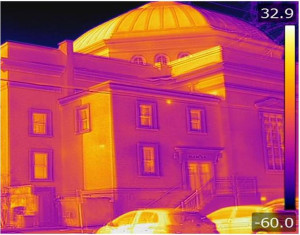
Thermographic image collected as part of the Algonquin College study of energy use.
High-efficiency Windows
Eleven of the building’s original windows have been replaced with high-efficiency glass panels. These represent a breakthrough in window technology, delivering about 2.5 times the insulating value of triple-pane windows. The high performance is accomplished by using heat mirror technology in a suspended film arrangement within the window. Removal of the original windows provided an opportunity to add insulation in the wooden frames, further increasing the thermal performance of the renovated windows.
Replacement of the old windows has significantly improved the comfort in the areas of the building where the new windows were installed. Installation of these 11 high-efficiency glass panels is estimated to result in an annual savings of about $700 and reduce greenhouse gas emissions by 4 metric tons of CO2e.
Detailed information on the design and performance of the high-performance glass panels can be found on the manufacturer’s website.
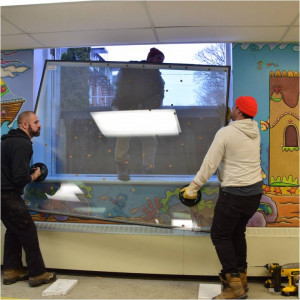
Installation of a high-efficiency glass panel in a the basement windows on the east side of the Community Centre.
Optimize Building Controls
New occupancy sensors make the community centre a smarter building. The new sensors allow the building’s control system to adjust air flow in response to the number of people using the main hall and the fitness room. Energy will not be wasted to by heating or cooling the space when it is not in use. The system will deliver only the amounts of heating, cooling and fresh air needed when these rooms are in use. This not only saves energy but also provides better air quality and improves occupant comfort. The new controls will save an estimated annual $1,705 and 489kg CO2e of greenhouse gases.
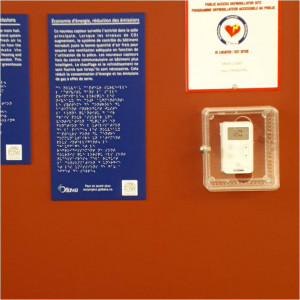
New sensors have been added in the main hall, shown next to one of the signs installed to inform the public of the results of this project.
Weatherproofing
An insulated fiberglass door replaces an uninsulated steel exit door in the northwest corner of the building. The new door includes an integrated frame that assures proper sealing against air leakage when the door is closed. New weatherstripping has also been installed around other exterior doors to improve their airtightness. The door replacement and weatherstripping greatly improves the insulating performance of the door and reduces the infiltration of outside air into the building, increasing occupant comfort.
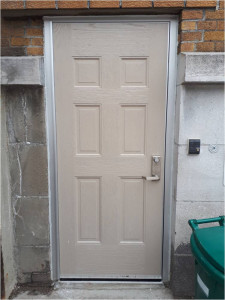
A new, insulated door with an integrated frame replaces an uninsulated steel exit door on the north side of the Community Centre.